

Getting a new mortgage to replace the original is called refinancing. Refinancing is done to allow a borrower to obtain a better interest term and rate. The first loan is paid off, allowing the second loan to be created, instead of simply making a new mortgage and throwing out the original mortgage. For borrowers with a perfect credit history, refinancing can be a good way to convert a variable loan rate to a fixed, and obtain a lower interest rate. Borrowers with less than perfect, or even bad credit, or too much debt, refinancing can be risky.
In any economic climate, it can be difficult to make the payments on a home mortgage. Between possible high interest rates and an unstable economy, making mortgage payments may become tougher than you ever expected. Should you find yourself in this situation, it might be time to consider refinancing. The danger in refinancing lies in ignorance. Without the right knowledge it can actually hurt you to refinance, increasing your interest rate rather than lowering it. Below you will find some of this basic knowledge written in order to help you reach your best deal. For comparative purposes, here is a rate table highlighting current rates in your area.
One of the main advantages of refinancing regardless of equity is reducing an interest rate. Often, as people work through their careers and continue to make more money they are able to pay all their bills on time and thus increase their credit score. With this increase in credit comes the ability to procure loans at lower rates, and therefore many people refinance with their mortgage companies for this reason. A lower interest rate can have a profound effect on monthly payments, potentially saving you hundreds of dollars a year.

Calculate Your Monthly & Total Interest Savings
Our home refinance calculator shows how much you can save locking in lower rates.
Second, many people refinance in order to obtain money for large purchases such as cars or to reduce credit card debt. The way they do this is by refinancing for the purpose of taking equity out of the home. A home equity line of credit is calculated as follows. First, the home is appraised. Second, the lender determines how much of a percentage of that appraisal they are willing to loan. Finally, the balance owed on the original mortgage is subtracted. After that money is used to pay off the original mortgage, the remaining balance is loaned to the homeowner. Many people improve upon the condition of a home after they buy it. As such, they increase the value of the home. By doing so while making payments on a mortgage, these people are able to take out substantial home equity lines of credit as the difference between the appraised value of their home increases and the balance owed on a mortgage decreases.
Refinancing is the process of obtaining a new mortgage in an effort to reduce monthly payments, lower your interest rates, take cash out of your home for large purchases, or change mortgage companies. Most people refinance when they have equity on their home, which is the difference between the amount owed to the mortgage company and the worth of the home.

Homeowners can choose to refinance for a variety of reasons including:

Cash Out Home Equity
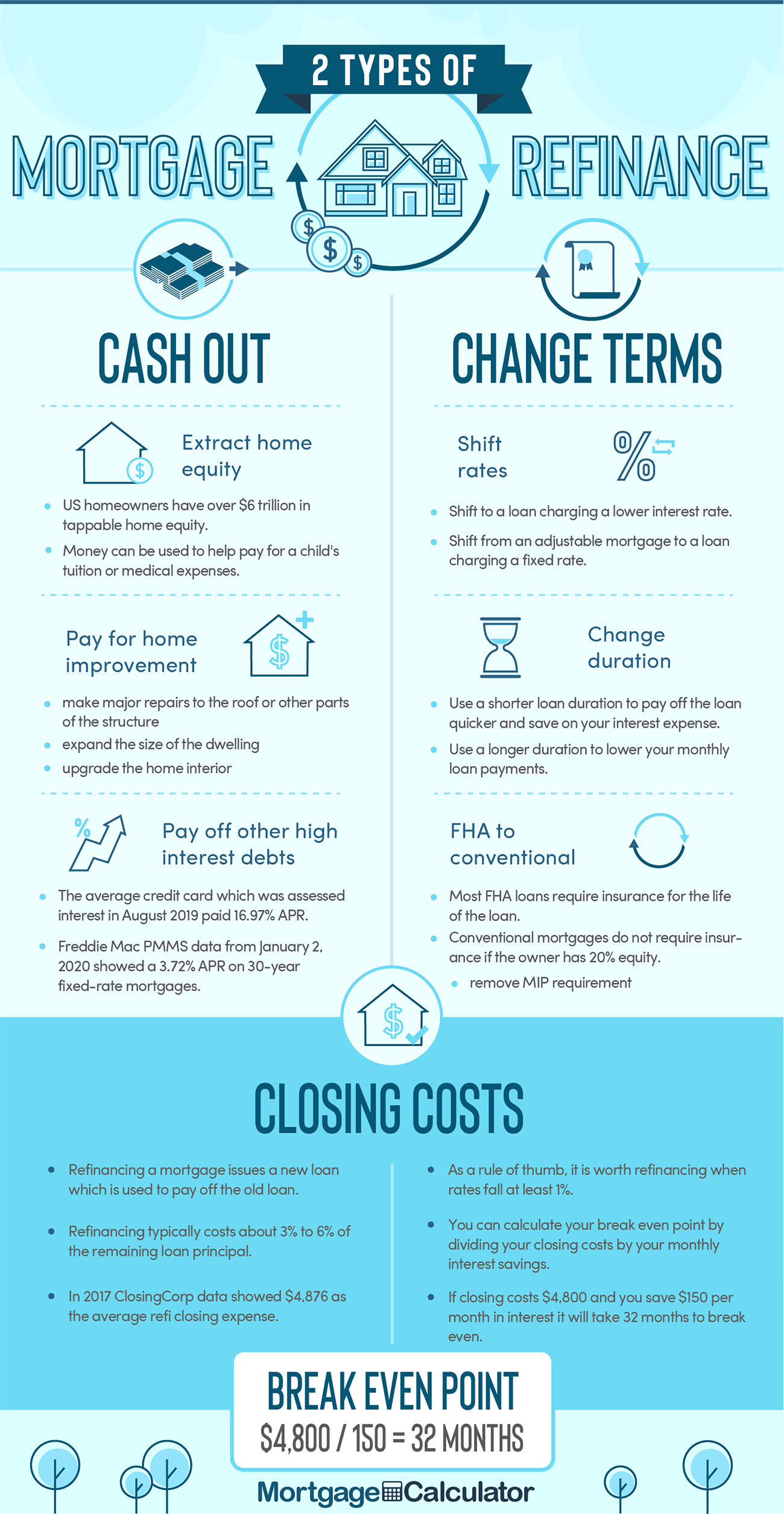
Homeowners can extract equity from the homes. The extracted equity can be used as a low-cost source of business funding, to pay off other higher-interest debts, of fund home renovations. If the equity is extracted to pay for home repairs or major home improvements the interest expense may be tax deductible.
Change Loan Duration
Homeowners can shorten duration to pay less interest over the life of the loan & own the home outright quicker; lengthen the duration to lower monthly payments.
Lower Interest Rates
If mortgage rates decline homeowners can refinance to lower their monthly loan payments. A one to two percent fall in interest rates can save homeowners tens of thousands of dollars in interest expense over a 30-year loan term.
Change Loan Structure
Borrowers who used an ARM to make initial payments more afforadable could shift to a fixed-rate loan after they built up equity & have progressed along their career path to increase their earnings.
Remove Mortgage Insurance Requirements
Some Federal government-backed loan programs like FHA loans and USDA loans may require ongoing mortgage insurance premium payments even after the homeowner has built up substantial equity, whereas a conventional loan no longer required PMI if the owner has at least 20% equity in the home. Many FHA or USDA borrowers who improve their credit profiles & income later shift into a conventional loan to remove the substantial monthly mortgage insurance payments.
The following graphic explores examples of why a home owner may choose to refinance.
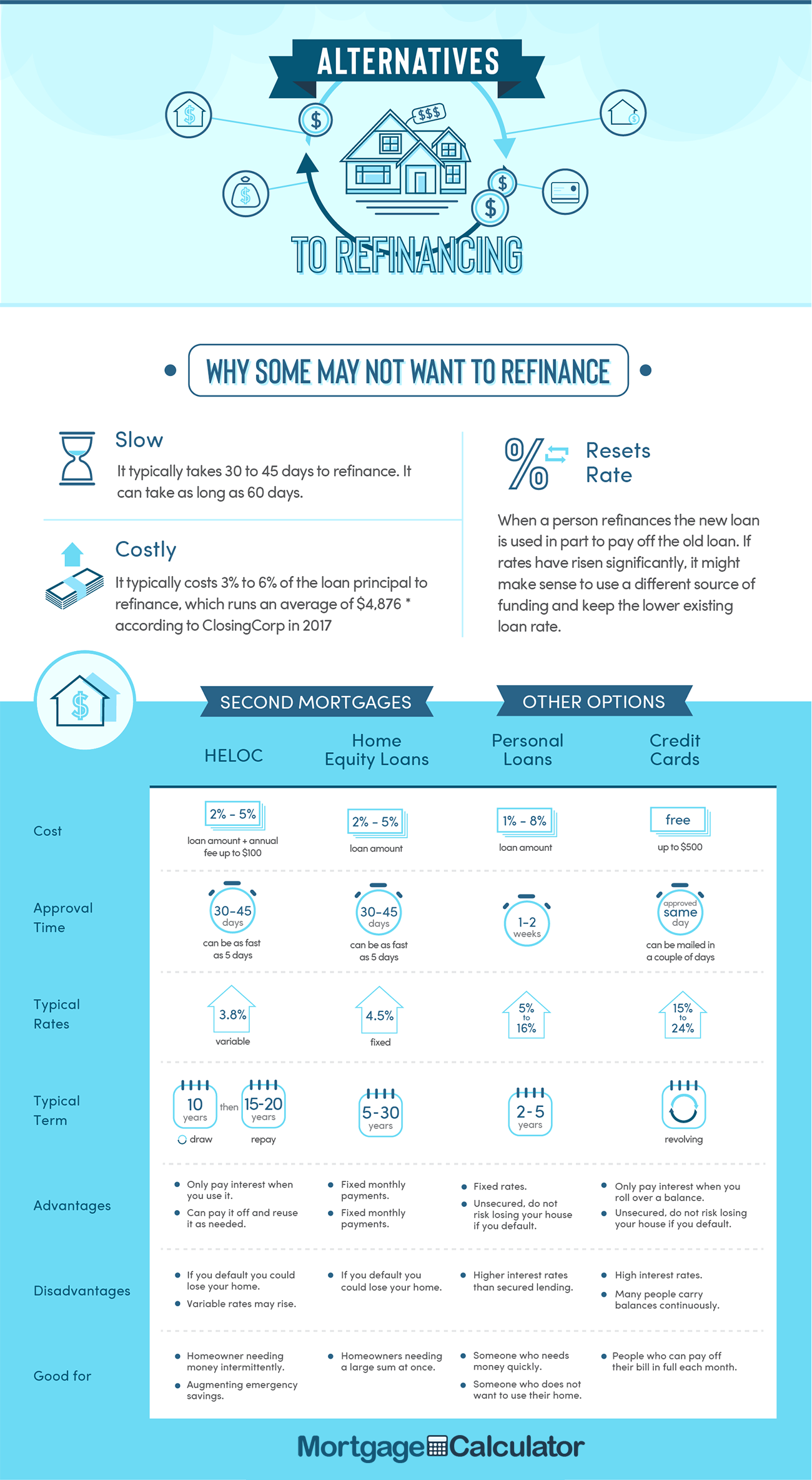
Rather than refinancing their home in whole, some homeowners who have built up significant equity & currently enjoy a low-rate loan can use a home equity loan or line of credit to tap their equity without resetting the rate on the remainder of their existing debt. A home equity loan is a second mortgage which operates similarly to the first mortgage, but usually charges a slightly higher rate. A home equity line of credit (HELOC) operates more like a credit card, as a revolving form of debt which can be drawn upon & paid off as convenient.
Our rate table lists current home equity offers in your area, which you can use to find a local lender or compare against other loan options. From the [loan type] select box you can choose between HELOCs and home equity loans of a 5, 10, 15, 20 or 30 year duration.
Consumers who need a small sum of cash for a short period of time may want to consider either credit cards or taking out an unsecured personal loan, though these typically charge significantly higher interest rates than loans secured by appreciating assets like second mortgages.
One of the major risks of refinancing your home comes from possible penalties you may incur as a result of paying down your existing mortgage with your line of home equity credit. In most mortgage agreements there is a provision that allows the mortgage company to charge you a fee for doing this, and these fees can amount to thousands of dollars. Before finalizing the agreement for refinancing, make sure it covers the penalty and is still worthwhile.
Along these same lines, there are additional fees to be aware of before refinancing. These costs include paying for an attorney to ensure you are getting the most beneficial deal possible and handle paperwork you might not feel comfortable filling out, and bank fees. To counteract or avoid entirely these bank fees, it is best to shop around or wait for low fee or free refinancing. Compared to the amount of money you may be getting from your new line of credit, but saving thousands of dollars in the long run is always worth considering.
The first thing you must do when considering refinancing is to consider exactly how you will repay the loan. If the home equity line of credit is to be used for home renovations in order to increase the value of the house, you may consider this increased revenue upon the sale of the house to be the way in which you will repay the loan. On the other hand, if the credit is going to be used for something else, like a new car, education, or to pay down credit card debt, it is best to sit down and put to paper exactly how you will repay the loan.
Also, you will need to contact your mortgage company and discuss the options available to you, as well as discussing with other mortgage companies the options they would make available. It may be that there is not a current deal which can be met through refinancing that would benefit you at the moment. If that is the case, at least you now know exactly what you must do in order to let a refinancing opportunity best benefit you. When refinancing, it can also benefit you to hire an attorney to decipher the meaning of some of the more complicated paperwork.
Most banks and lenders will require borrowers to maintain their original mortgage for at least 12 months before they are able to refinance. Although, each lender and their terms are different. Therefore, it is in the best interest of the borrower to check with the specific lender for all restrictions and details.
In many cases, it makes the most sense to refinance with the original lender, but it is not required. Bear in mind though, It's easier to keep a customer than to make a new one, so many lenders do not require a new title search, property appraisal, etc. Many will offer a better price to borrowers looking to refinance. So odds are, a better rate can be obtained by staying with the original lender.

Borrowers may consider refinancing for several different reasons, including but not limited to:
In general, refinancing includes the following closing costs outlined below:
1
Application fee. Lenders impose this charge to cover the cost of checking a borrowers credit report, and the initial cost to process the loan request.
2
Title insurance and title search. This charge covers the cost of a policy, which is usually issued by the title insurance company, and insures the policy holder for a specific amount, covering any loss caused by discrepancies found in the property's title. It also covers the cost to review public records to verify ownership of the property.
3
Lender's attorney review fees. The company or lawyer who conducts the closing will charge the lender for fees incurred, and in turn, the lender will charge those fees to the borrower. Settlements are conducted by attorneys representing the buyer and seller, real estate brokers, escrow companies, title insurance companies and lending institutions. In most situations, the individual conducting the settlement is providing their services to the lender. Borrowers may be required to pay for other legal fees and services related to their loan, which is then provided to the lender. They may want to retain their own attorney for representation in the settlement, and all other stages of the transaction.
4
Points and fees incurred in loan origination. Lenders charge an origination fee for their work in preparing and evaluating a mortgage loan. Points are prepaid financial fees which are imposed by the lender at closing. This is to increase the lending institution's yield beyond the agreed upon interest rate on the mortgage note. One point is equal to one percent of the actual loan amount.
Run the numbers to see if refinancing makes sense for you. Our home refinance calculator shows how much you can save locking in lower rates.
The Federal Reserve has hinted they are likely to taper their bond buying program later this year. Lock in today's low rates and save on your loan.
Are you paying too much for your mortgage?
Check your refinance options with a trusted New York lender.
Answer a few questions below and connect with a lender who can help you refinance and save today!
